Home
Videos ~ LIVE!
Water Flotation Belts
Water Weights
Stainless Water Bottles
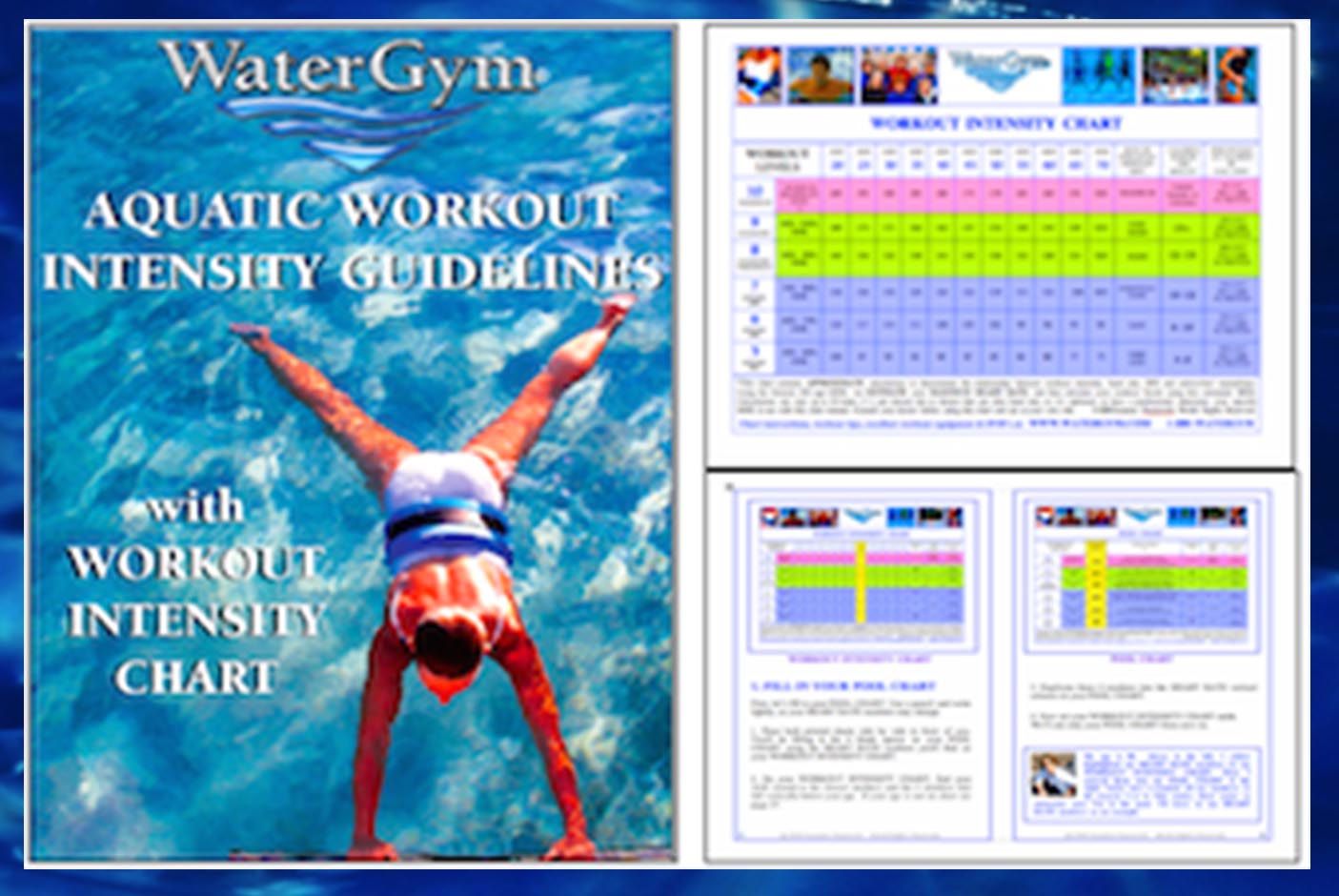
Workout Intensity Chart
Testimonials ~ LIVE!
Water Gym Classes
Water Gym Teachers
Trainings
Retreats
Water Gym FAQ
Contact Us
ORDER NOW!

WaterGym Water Aerobics Flotation Belt

FREE WATER AEROBICS EXERCISES
for you!

FREE WATER AEROBICS EXERCISES

Click on CHART and I'll see you on the next page! ~Susanne


WATERGYM BELTS
WEIGHTS & DVD'S ARE
MADE IN U.S.A.

Order ONLINE
or call toll free:
1- 888 - WATERGYM
(888-928-3749)
In CA (415) 435-1079

WATER AEROBICS AWARDS
San Jose Magazine's
2007 Reader's
Choice Award
Voted WaterGym
"Best Choice for
AQUATIC FITNESS"
and other press


FREE WATER AEROBIC EXERCISE CHARTS AND LIVE EXERCISES!


Welcome to WaterGym - A Fun, Effect Water Aerobic Workout!

Click on chart and your
FREE WATER AEROBICS EXERCISE CHART
will download to your desktop.
(An Adobe Acrobat PDF file)


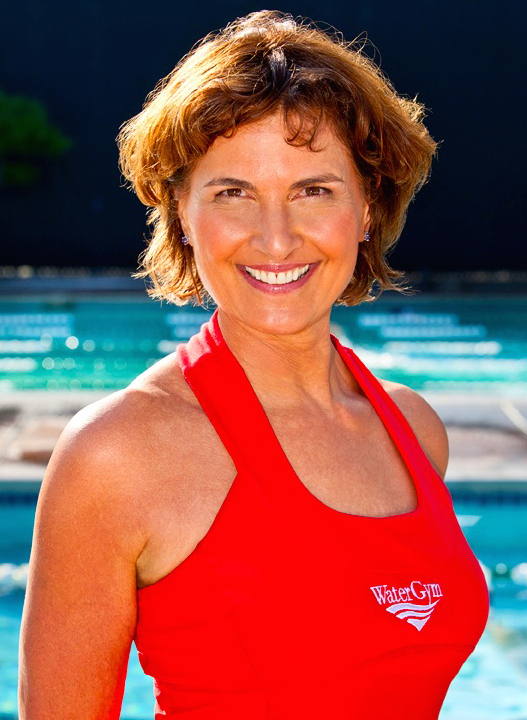
Susanne Paynovich


  Susanne Paynovich   Hi! Susanne again.... I hope you enjoyed the videos.
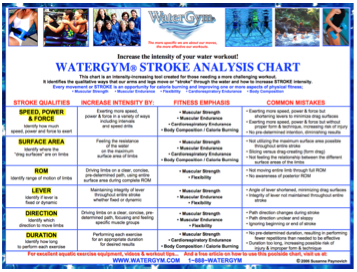
Above is the chart I promised and below is the article
I wrote for the Aquatic Exercise Association's AKWA Magazine (April/May 2006).
It's a bit technical, as it's written for professionals, but I am compelled to
sharing it with EVERYONE because it outlines the most IMPORTANT elements
for getting the most from your water workouts.

    
  You see, every movement you make in water is an opportunity to:
    • reduce body fat
    • tone and build lean muscle
    • strengthen abdominal muscles
    • increasing flexibility
    • improve cardiovascular conditioning, physical fitness and MORE!
    • improve all 5 aspects of physical fitness and MORE!

BUT ONLY if you pay attention to the QUALITY OF YOUR MOVEMENTS.

Let's be realistic...
One of the most beautiful aspects about water
is that it is a safe, wonderful, nurturing workout environment.

BUT...the downfall is that it feels SO good to be in water,
that sometimes we tend to float around and be a little lazy...
you know, a paddle here, chat a little with a friend or two, and a paddle there.

The quality of your movements in water directly determines your results.
The more specific you are the better your results.


Every time you move your arms or legs you have a choice to;
    • use the water as a powerful gym by specifically moving your limbs in a way that
        strengthens specific muscle groups and burns calories, or
    • use the water as a supportive environment to move easily and freely,
        which feels good, but gets minimal results

In your new chart I define the different ways your arms and legs can
STROKE through the water to maximize the benefits of your workout.
I also define the common mistakes that I have seen over the years
in which my clients tend to "cheat" to make their workouts easier
Remember, the specific way you move your arms and legs or
STROKE through the water greatly determines your results.

Enjoy the article and chart.... and don't forget to sign up to our mailing list
if you want our
TARGET HEART RATE CHART when it is ready. This new chart
will help you determine how many calories you're burning with your workouts.

Thanks! ~ Susanne


Be SPECIFIC ~ Get INTENSE!
STROKE ANALYSIS 101
by Susanne Paynovich, B.A.


This article appeared in
Aquatic Exercise Association's AKWA MAGAZINE (April/May 2006).
It has detailed instructions on how to use your
FREE WATERGYM® STROKE ANALYSIS CHART.


“Technique Cheaters”, …you know, those highly creative, adorable clients of ours that try to make their workouts easier by wiggling their way out of the proper execution of exercises. Don’t we just love them? (I’m smiling!) Well in truth, I couldn’t help but love one of mine, because the most creative cheater in all my years of teaching was one of my best friends, Merrily.

Quick, powerful, funny and packaged in a strong, robust frame with a 10-second attention span, Merrily would show up to my 7 a.m. class raring to go. Before I was barely awake, darling Merrily, “the powerhouse” would be looking up at me as if to say, “That move is too easy!” or “Is that all you’ve got?” So I’d pick up the pace, adding more speed, power and force to our moves. The class would moan. Merrily wouldn’t flinch. No matter what we did, she whizzed through it with ease. Her expertise at “finding the path of least resistance” throughout her life spilled into her pool techniques, testing every fiber of my teaching ability.

What was up? All my other clients were challenged, why wasn’t Merrily? Looking closer at her technique, I started to see creative ways that Merrily would tweak her moves to make them easier. A challenge turned blessing, her intensity-decreasing techniques compelled me to deeply explore the different qualitative ways that arms and legs could move or stroke through the water, resulting in either an increase or decrease in intensity. From this exploration I created the WATERGYM® STROKE ANALYSIS CHART to identify and define the most important STROKE QUALITIES and mistakes commonly associated with them. This chart is a great teaching tool to bring poolside, for you and your clients to use as a checklist helping clarify and intensify all moves. Take a moment to DOWNLOAD YOUR FREE WATERGYM® STROKE ANALYSIS CHART NOW, so that you can refer to it throughout the article.

Let’s explore how to use the chart by remedying two of Merrily’s favorite intensity-decreasing techniques that she performs with her legs. I call them “flicking” and “gapping”. We will use a common deep-water “Cross-Country Ski” move for our demonstration. But first, let’s establish proper body position and move execution.


#1 BODY POSITION

All deep-water moves must be rooted in a clearly defined and stable BODY POSITION to be effective. Otherwise, every time we move a limb we’re thrown off balance. Maintaining alignment in this dynamic environment, forces us to strengthen core stabilizer by engaging our abdominal muscles the entire workout. This stability allows us to direct our limbs with maximum power and precision. For this “Cross-Country Ski” deep-water move, we are in the VERTICAL BODY POSITION.

In VERTICAL, the spine is straight and aligned in neutral position, respecting all of its natural curves. The neck is lengthened, shoulders dropped, and abdominal muscles engaged to stabilize the torso. The body’s center of buoyancy (chest area and lungs) and center of gravity (pelvis) are in a vertical line. The arms are sculling out to the side to maintain balance.


#2 MOVE EXECUTION

Once aligned, Merrily begins her “Cross-Country Ski” move. Her arms and legs are in a fixed position as she swings them front to back in opposition on the sagittal plane. Her arms swing from her shoulders, elbows slightly bent, hands in fists, palms facing in. Her legs swing from her hips and are straight, without locking her knees. Her toes are pointed if possible.

THE PROBLEM
Now let’s define “FLICKING” and “GAPPING”.

“FLICKING”
While performing her “Cross-Country Ski” move, Merrily swings her legs from back to front back and she:

1) Initiates the forward stroke from her hip, but bends her knee and trails her foot
Merrily initiates the move from her hip, which is correct, but she doesn’t keep her leg in a fixed position. (LEVER)
Therefore, she is not using the entire front surface of her leg to create drag.
(SURFACE AREA)

2) Then she straightens her leg and “flicks” her foot to the front at the end of her stroke
Merrily finally remembers to use her lower leg for the stroke, but she’s not using the top surface of her foot to create drag.
Instead she flexes and flicks it, avoiding drag and focusing on flexibility by slicing through and stretching out.
(SURFACE AREA)

NOTE: Bending the knee and “flicking” the foot is usually a sign of weak hip flexors.
Merrily is compensating by minimizing the drag surfaces on the forward push of her leg.

“GAPPING”
While performing her “Cross-Country Ski” move, Merrily swings her legs from back to front and she:

1) Initiates her stroke by driving her legs on a clear, straight path, then diverts her path direction
Merrily begins the stroke path correctly, but halfway through the stroke her legs drift apart, creating a gap between her legs. (DIRECTION)

NOTE: “Gapping” can happen when the muscles needed to either initiate or complete a stroke are weak. Therefore, during the stroke, secondary muscles kick in, diverting the stroke direction. This could be due to many reasons, but most common for this move are weak hip flexors, or a quadriceps imbalance (vastus medialis weaker than vastus lateralis). “Gapping” also occurs when there is no inner leg awareness during the stroke.

THE REMEMDY
Now let’s refer to the WATERGYM® STROKE ANALYSIS CHART for a remedy to Merrily’s “flicking” and “gapping”. Using the history and examples I’ve already given you, you know that Merrily is a great example of how SPEED, POWER & FORCE are extremely important STROKE QUALITIES used to increase intensity. However, for Merrily and other very strong clients, it may not be enough. She is also a powerhouse and loves to stretch out, so her ROM and DURATION are fine. Therefore, 3 of the 6 STROKE QUALITIES on this chart are at optimum.

Since Merrily loves finding the “path of least resistance”, feeling more resistance is crucial. She also needs to stabilize her lever, and direct the way she drives her legs through the water. To remedy “flicking” and “gapping” Merrily needs to focus on the 3 other STROKE QUALITIES; SURFACE AREA, LEVER and DIRECTION. Let’s take them one at a time.


FOCUS ON
#3 LEVER

The first thing I asked Merrily to do was stabilize her levers, by keeping her limbs in a fixed position throughout the entire stroke. She was breaking at the knee, so I had her straighten and lengthen her leg, without locking her knee. At first this might be hard for some clients, because there might be inherent weaknesses that make this difficult. If this is the case, try:

• Shortening the angle of the lever (bend elbows or knees)
• Shortening the range of motion
• Diminishing form drag by flexing feet or slicing with hands


FOCUS ON
#4 SURFACE AREA

Once Merrily stabilized her levers, I had her try to feel all the drag creating SURFACE AREAS (highlighted in yellow in the illustration). There are 4 used for each stroke. All 4 SURFACE AREAS should be felt from the very onset of each stroke. Since the foot is at the end of the long lever of her leg, I asked her to initially focus on feeling just the tops of her feet on the forward stroke, eventually focusing on the entire SURFACE AREA.

Then I asked her to feel the connection and relationship of all 4 SURFACE AREAS to one another. For simplicity, we started with just 2 (see arrows). I asked, “Can you feel the entire bottom SURFACE AREA of your left arm pushing towards and in relationship to the entire top SURFACE AREA of your left leg as it swings forward?” Then I asked her to feel the relationship of the bottom SURFACE AREA of her left arm and the top SURFACE AREA of her right arm, and so on throughout the limbs. After experimenting with feeling the relationship between 2 SURFACE AREAS, then we focused on all 4 SURFACE AREAS simultaneously pushing towards center at the same time. This forms a rock solid relationship between our limbs and torso. It also helps us to initiate and connect from the onset of the stroke, preventing fragmentation of body parts and loss of mental focus.


FOCUS ON
#5 DIRECTION

Now Merrily was:
• Keeping her arms and legs in a fixed position the entire stroke
• Feeling all 4 SURFACES AREAS against the water resistance
• Feeling the relationship of all 4 SURFACE AREAS to one another

She now was ready to define a clear, concise direction for her stroke. Remember, she was “gapping”, which meant kicking her legs out to the side, creating a big gap between her legs. For Merrily, this was more of an awareness issue than a weakness. Asking her to drive her legs straight through center, I had her imagine that she was almost rubbing her knees together as they passed by one another. I say almost, because we need to drive the legs on the saggital plane in relationship to the width of her hips, no narrower than that. This begins an awareness of the medial surface of the leg.

Once established, we expanded her awareness from her knees to feeling the entire inner surface of her leg pushing through the resistance, from the top of her inner thighs all the way down to her feet. The medial side of the foot is an area that seems to frequently get ignored. It’s common to see a shortening of the inner leg as the foot supinates just slightly during the stroke. I asked her to really lengthen her inner leg and feel their relationship to one another as they passed by during each stroke.

At this point Merrily was finally utilizing all 6 STROKE QUALITIES; SURFACE AREA, LEVER, DIRECTION, ROM, SPEED FORCE & POWER, DURATION, and was really feeling challenged! In addition, these focused awareness exercises kept Merrily’s short attention span stimulated.


Now that you know how to use the WATERGYM® STROKE ANALYSIS CHART, you might consider deeply exploring one STROKE QUALITY at a time, since each offers a rich world unto itself. Eventually you can incorporate an awareness of all 6 with each move. In your exploration, make sure to only work with clients with whom increasing intensity is appropriate.

In closing, it is important to mention that most of the time our clients aren’t intentionally trying to “cheat”. Many times they’re just moving in water in a way that reflects how they move on land, reinforcing and strengthening their stronger muscle groups and avoiding the weaker ones. The beauty about water is that we can easily strengthen these weaker muscle groups in a safe environment with minimal risk of injury, comfortably liberated from common land–based gravitational challenges and restrictions.

Thank you for the opportunity to share this information with you. I hope it is helpful! I be presenting “Be SPECIFIC ~ Get INTENSE!” as a master class at the International Aquatic Fitness Convention in Orlando. Come by and say hello! Also, don’t forget to DOWNLOAD YOUR FREE WATERGYM® STROKE ANALYSIS CHART NOW. It is my gift to you for continually supporting WaterGym® throughout the years. Thank you!


Back to EXERCISES & CHARTS


Home | Water Aerobics Flotation Belt | Water Aerobics Videos / DVD | Water Weights | Water Bottles
Classes | Teachers | Retreats | Trainings | Testimonials | FAQ | Contact Us | Site Map | Photo Credits

WATER AEROBICS EXERCISE WORKOUTS FOR WATER FITNESS ENTHUSIASTS!

WaterGym LLC    P.O. Box 550    Tiburon, California   94920   USA
(toll free) 1-888-WATERGYM (888-928-3749) | In California: (415) 435-1079 | info@watergym.com
WaterGym is a Registered Trademark. Copyright 2005. World Rights Reserved.